Yes. Southern California is standard service; Las Vegas and other out-of-area shows are quoted to scope. Travel appears as its own line in the proposal, so you see the figure before you commit and nothing is added afterwards.
Service Area · Las Vegas
Racing simulator rental for Las Vegas trade shows.
Las Vegas runs the shows that decide the year. We bring the activation to your booth — simulators, a big-screen broadcast and a race director — delivered, staffed and broken down by our crew, so your team works the aisle instead of the equipment.
Not a drop-off rental.
We deliver, set up, run the format with a dedicated race director, and break it down afterwards. Nobody on your side assembles, staffs or troubleshoots anything. What we need from you is floor space and a wall outlet.
Custom liveries put your brand on the cars, the track and the broadcast — produced ahead of load-in and approved by your team.
What a racing grid does to a show floor.
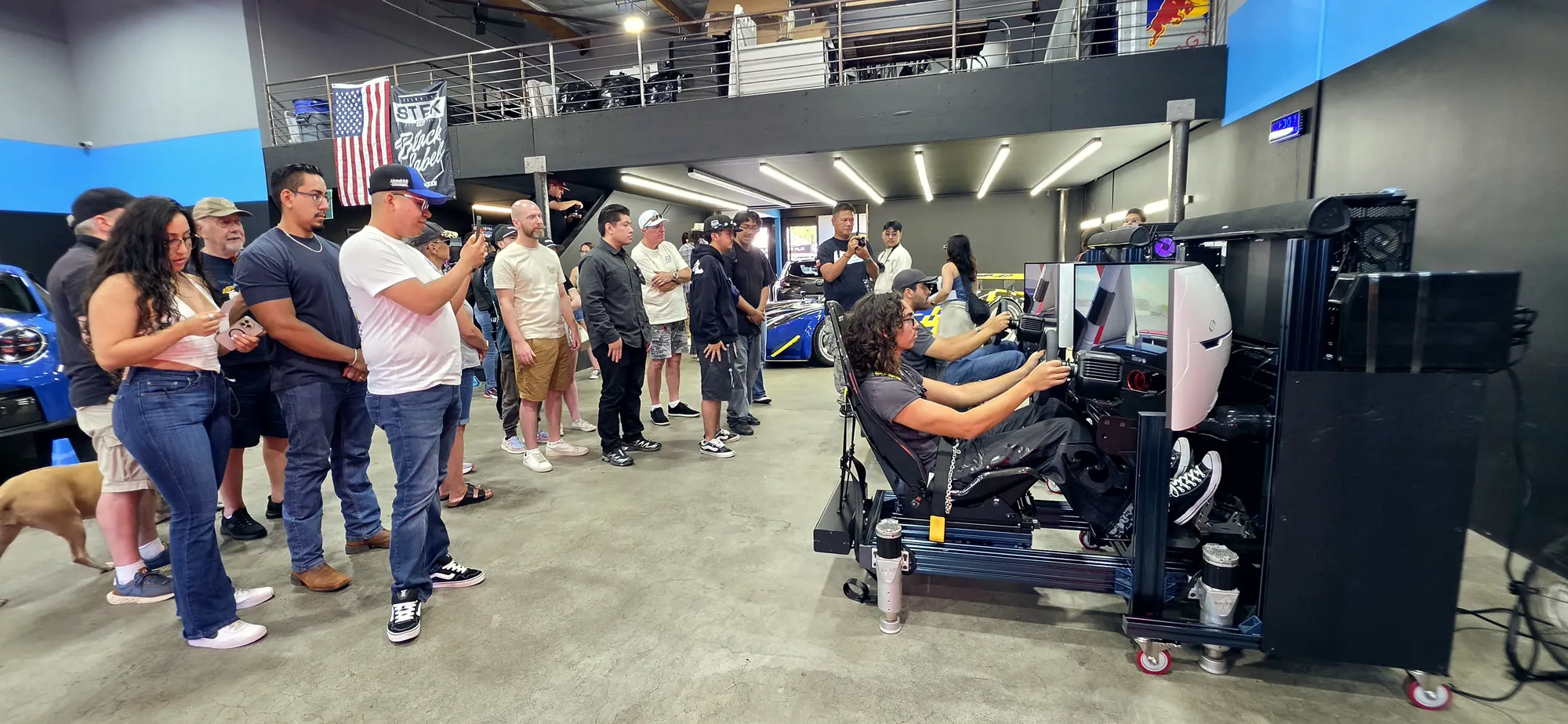
Attendees walk convention aisles in a scanning state, politely avoiding everyone paid to make eye contact with them. Signage does not interrupt that. Motion, sound and a crowd already gathered do — and a visible queue is the strongest traffic signal a booth can send.
Our most-measured example is Anaheim, not Nevada: at MD&M West a four-simulator booth ran 1,384 sessions over three days and put 589 unique drivers in the seat, with a queue that overflowed into the aisle. The full numbers are here. The floor dynamics are the same in a Las Vegas hall.
Fitting it into your booth.
A single simulator needs about 5 ft by 8 ft in operation; a pair with room to queue needs roughly 10 ft by 12 ft, so a 10x10 carries one station comfortably. Two to four concurrent stations raise throughput per hour in step with the space you give them.
Power is one standard 110V outlet per two rigs, and we confirm amperage requirements with the venue in advance.
Space & power
- Motion
- Full-motion
- Every rig. No static seats, no exceptions.
- Footprint
- 5′×8′
- Per rig in operation. 10′×12′ for a pair with room to queue.
- Power
- 1 outlet
- One standard 110V outlet per two rigs. No generators, no special wiring.
- Throughput
- 15–20
- Guests per hour, per simulator. Multiplies with every rig you add.
Show logistics.
We work within your exhibitor kit, load-in windows and any union labour rules — which matter more in Las Vegas than almost anywhere. Delivery, install, staffing and teardown are ours, load-in to load-out, with a COI on file and run-of-show coordination with show management.
For multi-day programs our crew runs the footprint continuously across every show day, and the post-event report comes back with sessions, unique drivers and exposure hours.
Travel and lead time.
Plan on three to six months for a major Las Vegas show, where booth space and show deadlines drive the calendar. Multi-day deployments are quoted to scope around your footprint, show days and KPIs.
Travel to Las Vegas is quoted to scope in the same proposal — transparently, with no hidden fees, and you see the figure before you commit.
Out-of-area does not mean out of scope.
Las Vegas is quoted to scope rather than sold off a rate card, because a show there carries costs a Southern California ballroom does not: travel and accommodation for the crew, freight, advance warehouse deadlines, and whatever the show’s own labour rules add on top.
All of it appears in the proposal as its own line. What does not change is who does the work — the same crew travels, the same race director runs the format, and load-in to load-out stays ours. You are buying a different cost base, not a thinner service.
Plan around the freight deadline, not the show date.
The date that actually constrains a Las Vegas activation is rarely opening day. It is the advance warehouse cut-off, which can land weeks earlier and at a materially lower rate than shipping direct to show site. Miss it and the same equipment costs more to get into the same hall.
That is why we ask for the show and booth number early. Once those are known, the freight, drayage and labour windows resolve into a schedule, and the schedule is what makes the quote honest rather than optimistic.
Common questions
Yes. We coordinate with the general service contractor and venue exhibitor services, work inside your move-in window and labour requirements, and handle drayage and advance warehouse shipments at advance rates when the show requires them.
As early as you have them. The advance warehouse cut-off usually lands weeks before opening day and at a lower rate than shipping to show site, so the show name and booth number are what let us build a schedule rather than an estimate.
A single simulator needs about 5 ft by 8 ft in operation, and a pair with room to queue needs roughly 10 ft by 12 ft — so a 10x10 carries one station comfortably. Tell us your booth size and we will recommend a configuration.
Yes — our crew runs the footprint continuously across every show day, load-in to load-out, with a COI on file and run-of-show coordination with show management. The post-event report comes back with sessions, unique drivers and exposure hours.
The format, measured
- —MD&M West · Anaheim Convention Center — 589 unique drivers and ~323 brand-exposure hours across three days.
- —7th Sense Research · Long Beach Grand Prix — ~800 drivers engaged across three days on two simulators.
- —Bimmer Invasion · Pomona Fairplex — 106 drivers inside a 10,000-guest festival, 40% back for a second run.
- —Booth ideas ranked by stopping power — an honest tier list.
- —How to increase booth traffic — what the aisle actually responds to.
Exhibiting in Las Vegas?
Tell us the show, your booth number and size. One reply within one business day — availability and a single recommended configuration.