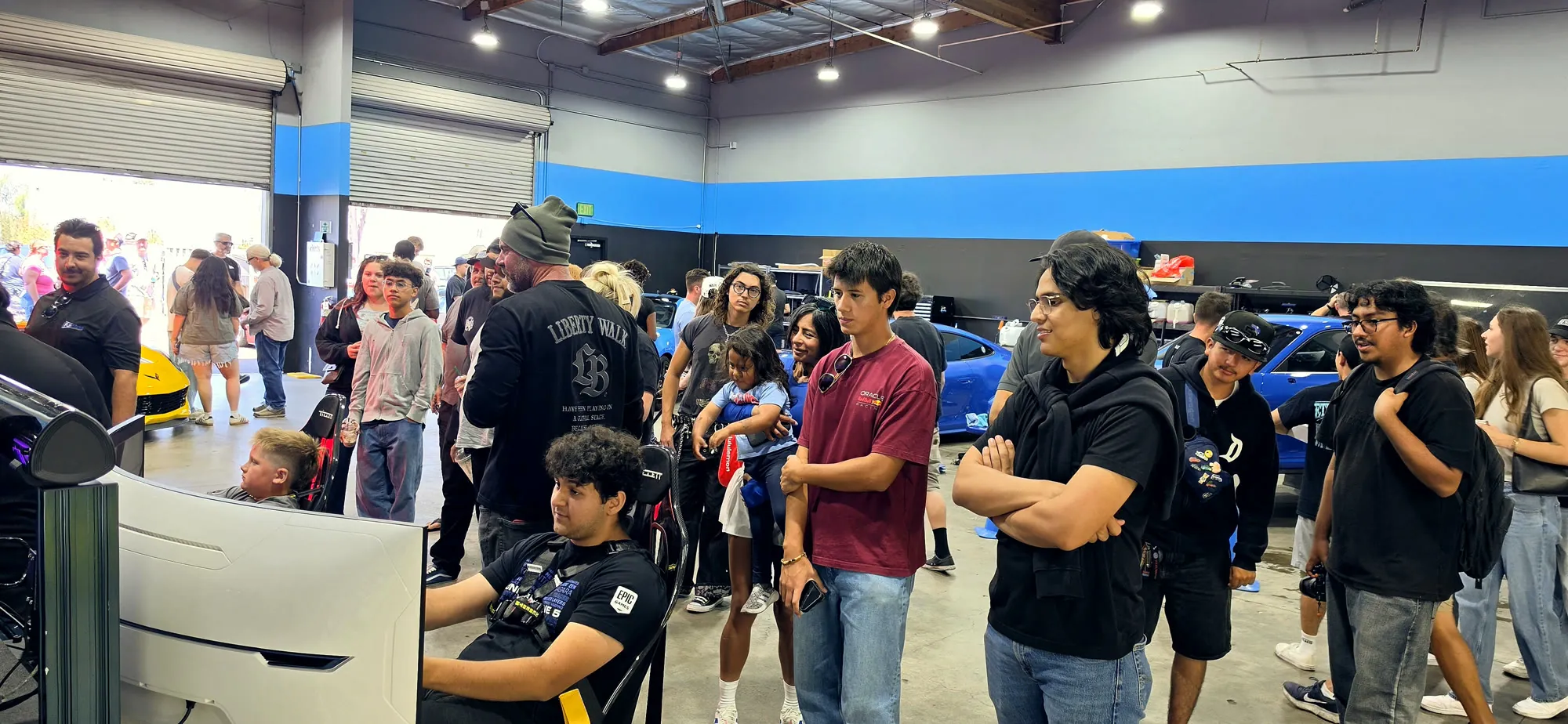
Each simulator runs about 15 to 20 drivers per hour, and that multiplies with every rig. Three simulators — our most-booked setup — put roughly 90 to 120 drivers through a two-hour window, so everyone at a 100-person off-site gets a turn without a queue that stalls.
Guide · Corporate Events
Team building activities that don’t feel like team building.
The phrase makes people wince for a reason. Most team building asks colleagues to perform enthusiasm on command. The formats that work do not announce themselves as team building at all — they just give the group something worth competing over.
Why most team building underperforms.
Two failure modes. Either the activity rewards a skill most of the room does not have, so half the team spectates and quietly resents it — or it is so gentle that nobody engages and everyone checks their phone.
What you want is a narrow skill gap, a short feedback loop, and a public score. Everyone can participate honestly, and the result is not predetermined by who plays golf.
What a shared competition does instead.
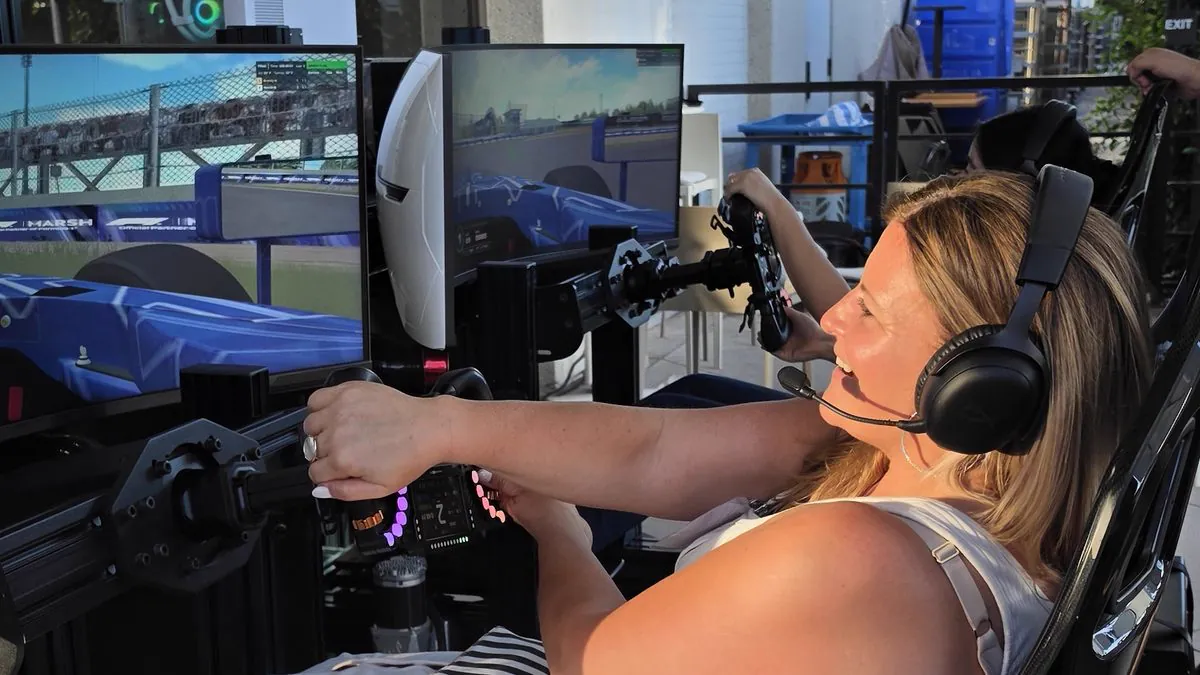
A racing grid puts every person through the same three-minute test with the same car on the same track. The leaderboard climbs on a big screen, and a dedicated race director runs the format like a broadcast — qualifying, heats, a grand final.
The result is that the room watches each other. People who would not otherwise talk end up comparing sector times, and the conversation carries past the event.
It is built for people who have never done it.
89% of our drivers are first-timers. The rigs are set up so that someone who has never held a racing wheel is competitive within a lap or two, which is the whole point — a format only works for team building if the newest person has a real chance.
Group size and timing.
Programs scale by simulator count. Each rig runs about 15 to 20 drivers per hour, and that throughput multiplies with every simulator you add — so three rigs, our most-booked setup, keep a steady grid running for anything from an intimate executive dinner up to a 200-guest off-site.
Sessions are timed and short, so the queue keeps moving and the format fits alongside an agenda rather than replacing it.
The gap between the fastest and slowest driver is the point.
At a Mercer reception in Irvine, the quickest lap of the night was a 0:56.039. The field average was 1:20.963 — nearly twenty-five seconds between the fastest driver in the room and the typical one. That spread is the most useful number we have for judging a team format.
Too narrow a gap and there is no contest worth watching. Too wide and half the room stops trying. Twenty-five seconds across a minute-long lap is wide enough that winning means something, and narrow enough that the slowest driver still completes the lap, still posts a time, and still has something to compare.
Fitting it around the rest of the day.
Sessions are timed and short, and the grid runs continuously, so the format occupies a window rather than the whole day. Three shapes cover most of what we run: a ninety-minute block after the working sessions end, an open grid that runs through a two-hour reception, or a structured qualifying-to-final program of about three hours that ends on a podium.
A dedicated race director runs the format start to finish, which matters more than it sounds. Nobody on your team has to MC, keep time, explain the controls, or decide who goes next — the parts of an off-site that usually fall to whoever organised it.
What we need from your venue.
Less than most people expect. Each simulator takes a footprint of about 5 ft wide by 8 ft deep in operation, and a pair with room to queue needs roughly 10 ft by 12 ft. Two rigs run off a single standard 110V wall outlet — no generators, no special wiring, no rewiring your ballroom.
We load in about three hours before doors and are packed out about an hour after close, all off the clock and outside your event hours. Indoors or out, ballroom or parking lot — exact arrival and clear times go into your run-of-show with the proposal.
Space & power
- Motion
- Full-motion
- Every rig. No static seats, no exceptions.
- Footprint
- 5′×8′
- Per rig in operation. 10′×12′ for a pair with room to queue.
- Power
- 1 outlet
- One standard 110V outlet per two rigs. No generators, no special wiring.
- Throughput
- 15–20
- Guests per hour, per simulator. Multiplies with every rig you add.
What is included.
Everything needed to run the experience: a dedicated race director running the show, professional simulators, a live leaderboard and custom intro screens — plus delivery, setup and breakdown within 30 miles. Pricing is flat and starts at $3,200, and every package includes five full event hours. Setup and breakdown are on us, off the clock.
Custom liveries — your brand on the cars, the track and the broadcast — are included from The Grand Prix tier up and available as an add-on on any tier. The full package breakdown is on the pricing page.
Common questions
It is built for them. 89% of our drivers are first-timers. The rigs are set up so someone who has never held a racing wheel is competitive within a lap or two — a team format only works if the newest person has a real chance, so that is the setup we optimise for.
No. Each simulator needs about 5 ft by 8 ft in operation, and a pair with room to queue needs roughly 10 ft by 12 ft. Two rigs run off a single standard 110V outlet — no generators, no special wiring. Ballroom, office lobby, warehouse or parking lot all work.
Yes, and it often does. Because sessions are short and timed, the grid runs during breaks and receptions without competing with programming. A persistent leaderboard gives people a reason to come back between sessions rather than drifting off.
Pricing is flat and starts at $3,200 for two simulators across five event hours. Three simulators — the setup most groups choose — is $4,500. Delivery, setup, a dedicated race director and breakdown are included, and setup and breakdown happen off the clock.
Proof from the floor
- —Mercer · Formula 1 celebration, Irvine — 35 named drivers, 106 laps, and a room that stayed past close to hear the standings.
- —Epay Policy · Insurance Fest, Santa Monica Pier — 54 named contacts and roughly 18 hours of decision-maker attention in a single day.
- —Corporate event ideas — six occasions and what each one actually needs.
- —Conference entertainment — running in the gaps rather than against the agenda.
Building an off-site or team day?
Tell us the date, the room and the headcount. One reply within one business day — availability and a single recommended program.