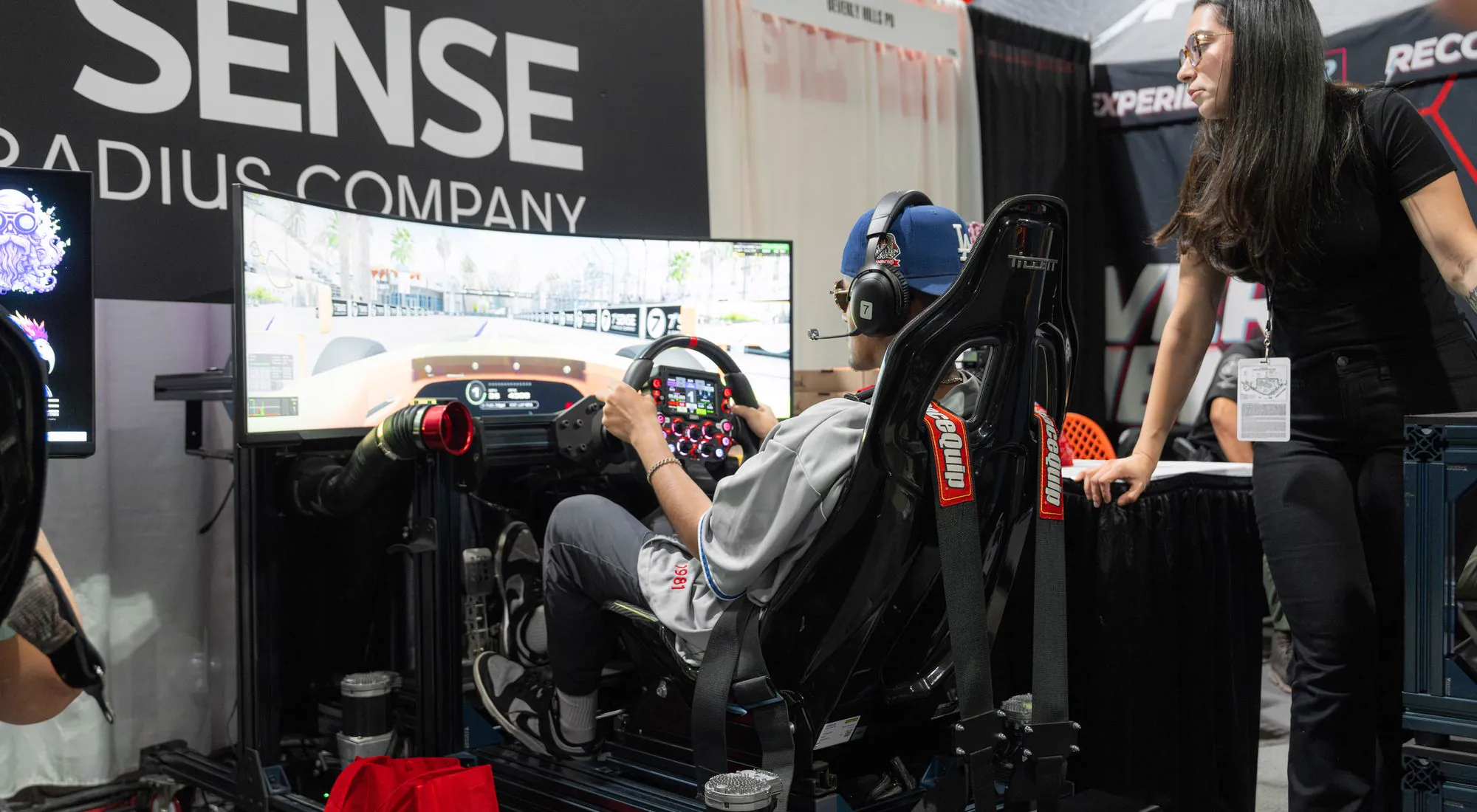
It sits well away from the band or DJ — a patio, a side room, or under tenting outdoors. The draw is the screens and the leaderboard rather than volume, so it runs alongside the main floor without either competing with the other.
Private Events · Weddings
Wedding entertainment for the hours between the toasts and the last song.
Every wedding has a gap — after dinner, before the dancing really starts, when half the room is seated and the other half is outside. A racing grid gives that stretch somewhere to go, for the guests who were never going to dance.
It is for the half of the room that is not dancing.
A wedding crowd splits. Some people are on the floor all night; plenty are not, and they tend to be the ones checking their phones by ten. A shared competition gives that group a reason to stay, and gives the two families something to do together that is not small talk.
Guests race wheel-to-wheel, a leaderboard climbs on the big screen, and it builds to a podium — a photo moment that is not another posed group shot.
Nobody has to be good at it.
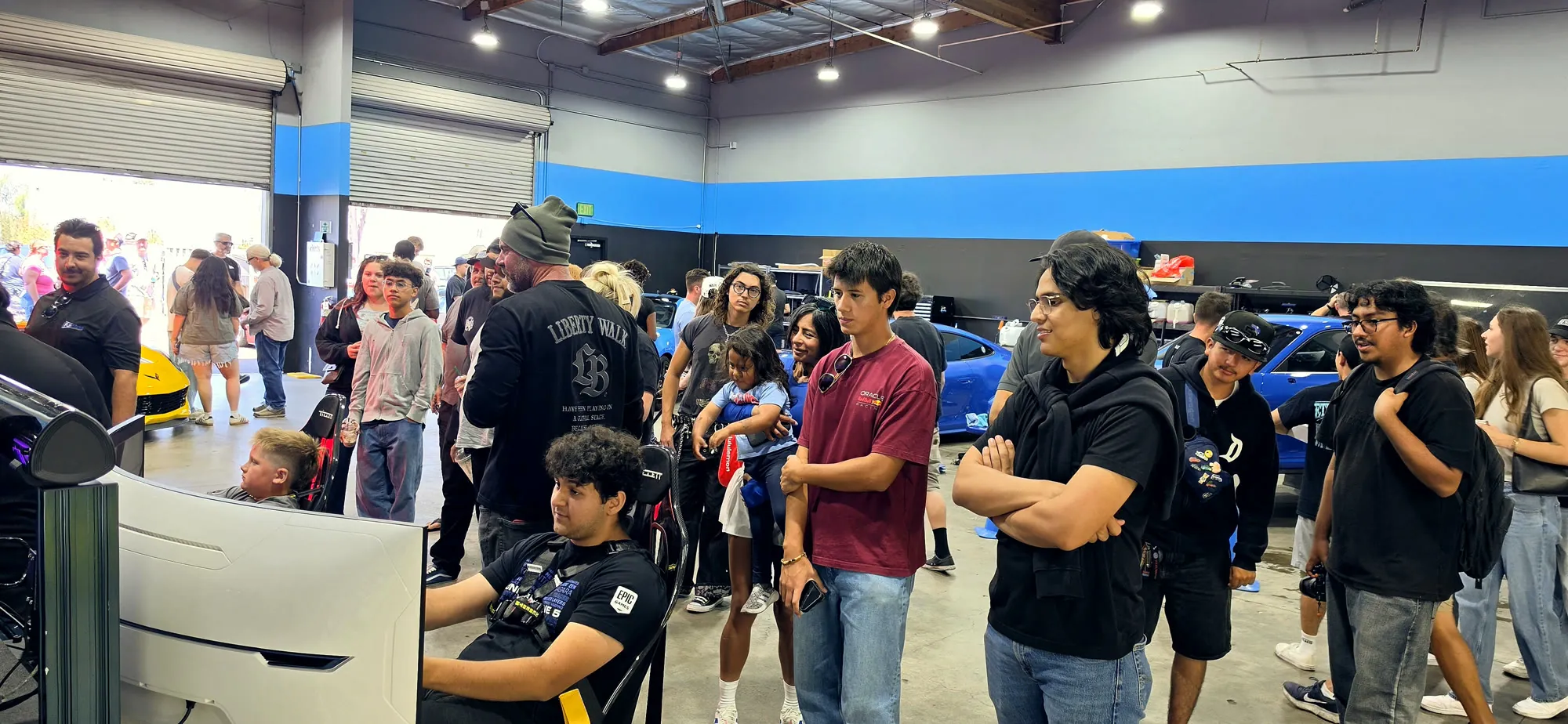
89% of our drivers have never touched a simulator. Sessions are short and timed, so the queue keeps moving and grandparents, kids and the groomsmen all get a turn on the same track in the same car.
It runs without anyone from the wedding party.
A dedicated race director MCs the format, manages the grid and keeps the energy up. Nobody in the wedding party hosts it, explains it or watches the clock.
We load in about three hours before doors and are packed out about an hour after close, off the clock and outside your event hours — so it never collides with the timeline your coordinator has built.
What we need from your venue.
Less than most people expect. Each simulator takes a footprint of about 5 ft wide by 8 ft deep in operation, and a pair with room to queue needs roughly 10 ft by 12 ft. Two rigs run off a single standard 110V wall outlet — no generators, no special wiring, no rewiring your ballroom.
We load in about three hours before doors and are packed out about an hour after close, all off the clock and outside your event hours. Indoors or out, ballroom or parking lot — exact arrival and clear times go into your run-of-show with the proposal.
Space & power
- Motion
- Full-motion
- Every rig. No static seats, no exceptions.
- Footprint
- 5′×8′
- Per rig in operation. 10′×12′ for a pair with room to queue.
- Power
- 1 outlet
- One standard 110V outlet per two rigs. No generators, no special wiring.
- Throughput
- 15–20
- Guests per hour, per simulator. Multiplies with every rig you add.
What is included.
Everything needed to run the experience: a dedicated race director running the show, professional simulators, a live leaderboard and custom intro screens — plus delivery, setup and breakdown within 30 miles. Pricing is flat and starts at $3,200, and every package includes five full event hours. Setup and breakdown are on us, off the clock.
Custom liveries — your brand on the cars, the track and the broadcast — are included from The Grand Prix tier up and available as an add-on on any tier. The full package breakdown is on the pricing page.
Who it is actually for.
Not the dance floor crowd. They are already handled, and nothing here is trying to compete with a good band. This is for the other half of your guest list: the college friends who will not dance, the teenagers, the uncles, and the people who quietly step outside at nine and do not come back.
That group is usually written off as unavoidable. It is not — they will happily stay for three hours if the room gives them something to do that is not dancing and not small talk.
Where it goes, and when.
Cocktail hour and the back half of the reception are the two placements that work. Outdoors under tenting, on a patio, or in a side room off the main floor — far enough from the band that neither is fighting the other, close enough that guests drift between them.
A race director runs the whole thing, so no one in your wedding party is explaining controls or keeping a list. Timed sessions keep the queue moving, and the standings give the group a running joke for the rest of the night.
What we do not do.
We bring the racing and everything that runs it. Catering, bar service and general venue AV stay with you or your venue — we do not quote or coordinate them. It keeps the scope clean and the quote honest.
We carry liability coverage and provide a Certificate of Insurance for your venue on request, along with a run-of-show your facilities and AV teams can work from.
Common questions
About 5 ft by 8 ft per simulator in operation, and roughly 10 ft by 12 ft for a pair with room to queue. Two rigs run off a single standard 110V outlet, so most venues need to do nothing but point us at the space.
Cocktail hour and the back half of the reception are the two that work best. Cocktail hour gives arriving guests something to do before dinner; the back half holds the people who would otherwise start leaving once the formal part of the night is over.
Yes, and they are often the most committed drivers in the room. The rigs are set up so a first-timer is competitive within a lap or two, which is the same reason they work for guests of any age who have never done it before.
We bring the racing and everything that runs it — simulators, screens, cabling, crew and a race director — and we load in about three hours before doors and are packed out about an hour after close, off the clock. Catering, bar and general venue AV stay with you or your venue.
What the format looks like in a room
- —Mercer · Formula 1 celebration, Irvine — 35 named drivers, 106 laps, and a room that stayed past close to hear the standings.
- —DSF Werks · Pit Stop fundraiser, Long Beach — two simulators as the gathering point of the lot.
- —Holiday party entertainment — the two-thirds of the room who were never going to dance.
- —Corporate event ideas — six occasions and what each one actually needs.
Planning a wedding?
Tell us the date, the venue and the headcount. One reply within one business day — availability and a single recommended program.