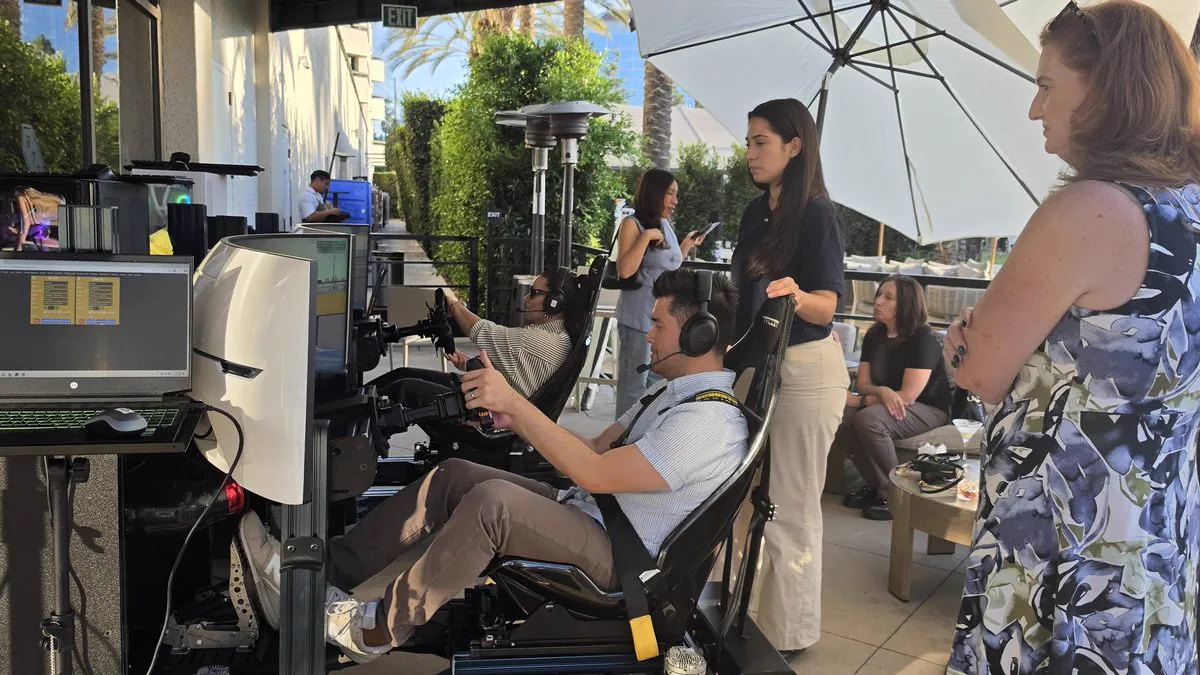
A format with a narrow skill gap, a short feedback loop and a public score. Everyone can take part honestly, and the result is not decided by who already plays the sport. Racing works for this because 89% of our drivers have never done it before and are competitive within a lap or two.
Guide · Corporate Events
Corporate event ideas that people actually remember.
Most corporate entertainment is forgotten by the following Monday. The formats that survive have one thing in common — they give the room something to do together, with a visible outcome. Here is how the good ones differ, and what a racing grid actually takes to run.
The problem with passive entertainment.
A band, a photo booth, a casino table — each occupies a corner of the room and waits. Guests drift past, take a turn, drift on. Nothing accumulates, so there is nothing to talk about afterwards.
The formats people still reference months later share a structure: everyone participates, there is a public score, and the night builds to a moment. That is a competition, not an attraction.
Six occasions, and what each one needs.
- —Holiday & year-end parties. A marquee centerpiece that makes the annual celebration the one people actually remember.
- —Team off-sites & retreats. Competitive, inclusive and easy to run alongside the agenda — it brings the room together fast.
- —Client & VIP appreciation. A premium, high-touch experience that signals you spared no detail for the people who matter.
- —Sales kickoffs. Leaderboard-driven competition that channels the room’s intensity into one shared moment.
- —Executive & board functions. Refined, professionally staffed and discreet — an activation that suits a senior audience.
- —Grand openings & milestones. A crowd-drawing spectacle that turns a date on the calendar into an event worth attending.
Why racing works on a mixed room.
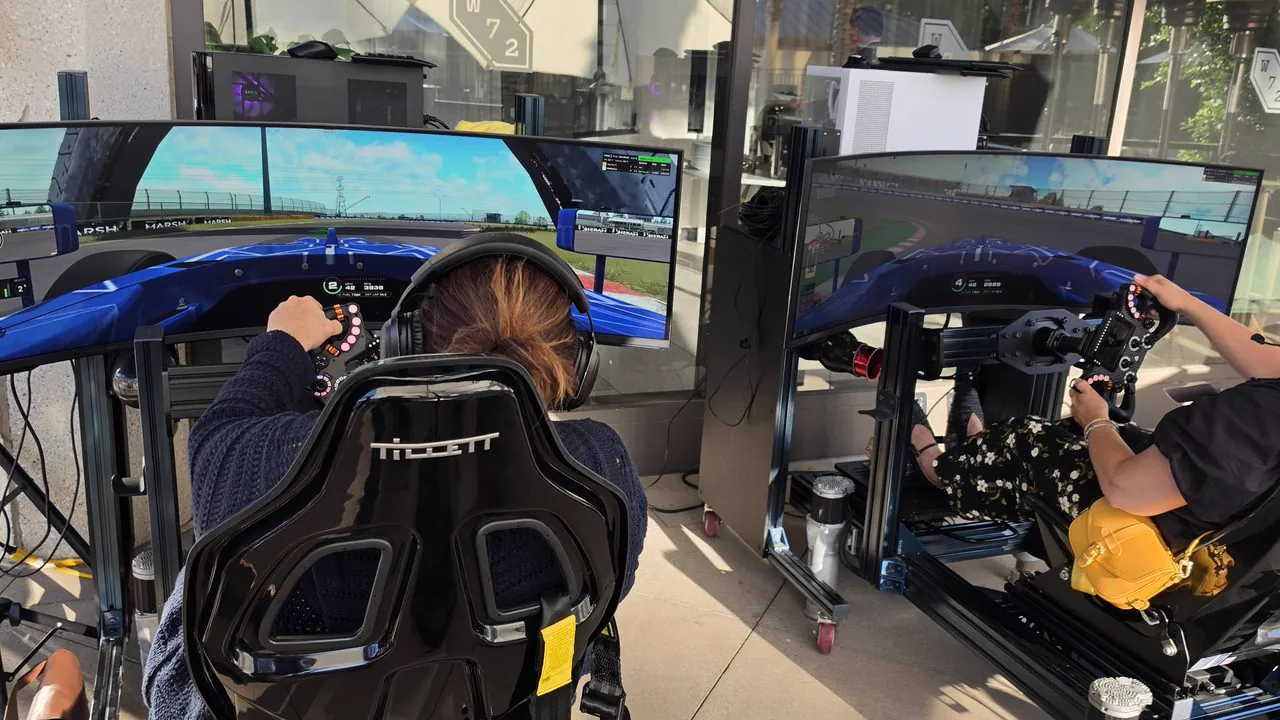
Nobody has to be good at it. A qualifying → heats → grand-final format keeps everyone engaged rather than just the person in the seat, and a race director MCs the whole thing so no one on your team has to play host.
Across our activations, 89% of drivers had never touched a simulator before. First-timers are the format’s core audience, not an edge case.
What we need from your venue.
Less than most people expect. Each simulator takes a footprint of about 5 ft wide by 8 ft deep in operation, and a pair with room to queue needs roughly 10 ft by 12 ft. Two rigs run off a single standard 110V wall outlet — no generators, no special wiring, no rewiring your ballroom.
We load in about three hours before doors and are packed out about an hour after close, all off the clock and outside your event hours. Indoors or out, ballroom or parking lot — exact arrival and clear times go into your run-of-show with the proposal.
Space & power
- Motion
- Full-motion
- Every rig. No static seats, no exceptions.
- Footprint
- 5′×8′
- Per rig in operation. 10′×12′ for a pair with room to queue.
- Power
- 1 outlet
- One standard 110V outlet per two rigs. No generators, no special wiring.
- Throughput
- 15–20
- Guests per hour, per simulator. Multiplies with every rig you add.
What is included.
Everything needed to run the experience: a dedicated race director running the show, professional simulators, a live leaderboard and custom intro screens — plus delivery, setup and breakdown within 30 miles. Pricing is flat and starts at $3,200, and every package includes five full event hours. Setup and breakdown are on us, off the clock.
Custom liveries — your brand on the cars, the track and the broadcast — are included from The Grand Prix tier up and available as an add-on on any tier. The full package breakdown is on the pricing page.
How far ahead to book.
Plan on four to six weeks for a corporate event, and three to six months for a trade show where booth space and show deadlines drive the calendar. We accommodate shorter timelines when the calendar allows, and we reply to every inquiry within one business day with availability and a single recommended program.
How to judge an idea before you book it.
Three questions separate the ideas that work from the ones that photograph well. What share of the room actually participates, rather than watches? How long does it hold one person’s attention? And does anything survive the night — a score, a photo, a story someone repeats on Monday?
Most entertainment fails the first question. A band, a magician, a comedian: the room is an audience, and participation is zero by design. That is not a flaw if you want a show. It is a flaw if you wanted the room to mix, because a passive format gives people no reason to talk to anyone they did not arrive with.
The failure modes nobody warns you about.
Four, in rough order of how often we see them. Entertainment that competes with your programme instead of fitting inside it. A format that peaks in the first twenty minutes and then has nowhere to go. Anything that rewards a skill half the room does not have, which quietly splits the guest list into players and spectators. And vendors who leave the logistics — power, load-in, teardown, the run-of-show — sitting with you.
The last one is the easiest to screen for. Ask any vendor what they need from the venue, who handles load-in, and what time they are out. If the answer moves work onto your plate, that cost is real even though it never appears on the quote.
Common questions
Four to six weeks for a corporate event, and three to six months for a trade show where booth space and show deadlines drive the calendar. We accommodate shorter timelines when the calendar allows, and we reply to every inquiry within one business day.
Flat pricing starts at $3,200 for two simulators across five event hours, $4,500 for three, and from $6,500 for four or more. Delivery, setup, a dedicated race director and breakdown are included in every tier. Multi-day deployments are quoted to scope.
Space and power, and nothing else. About 5 ft by 8 ft per simulator in operation, roughly 10 ft by 12 ft for a pair with room to queue, and one standard 110V outlet for every two rigs. We load in about three hours before doors and are packed out about an hour after close, off the clock.
No, and we will say so early. We bring the racing and everything that runs it — simulators, screens, cabling, crew and a race director. Catering, bar service and general venue AV stay with you or your venue. It keeps the scope clean and the quote honest.
Proof from the floor
- —Mercer · Formula 1 celebration, Irvine — 35 named drivers, 106 laps, and a room that stayed past close to hear the standings.
- —Epay Policy · Insurance Fest, Santa Monica Pier — 54 named contacts and roughly 18 hours of decision-maker attention in a single day.
- —MD&M West · Anaheim Convention Center — 589 unique drivers and ~323 brand-exposure hours across three days.
- —Team building activities — why most formats underperform, and what a narrow skill gap changes.
- —Holiday party entertainment — the two-thirds of the room who were never going to dance.
Planning a corporate event?
Tell us the date, the room and the headcount. One reply within one business day — availability and a single recommended program.