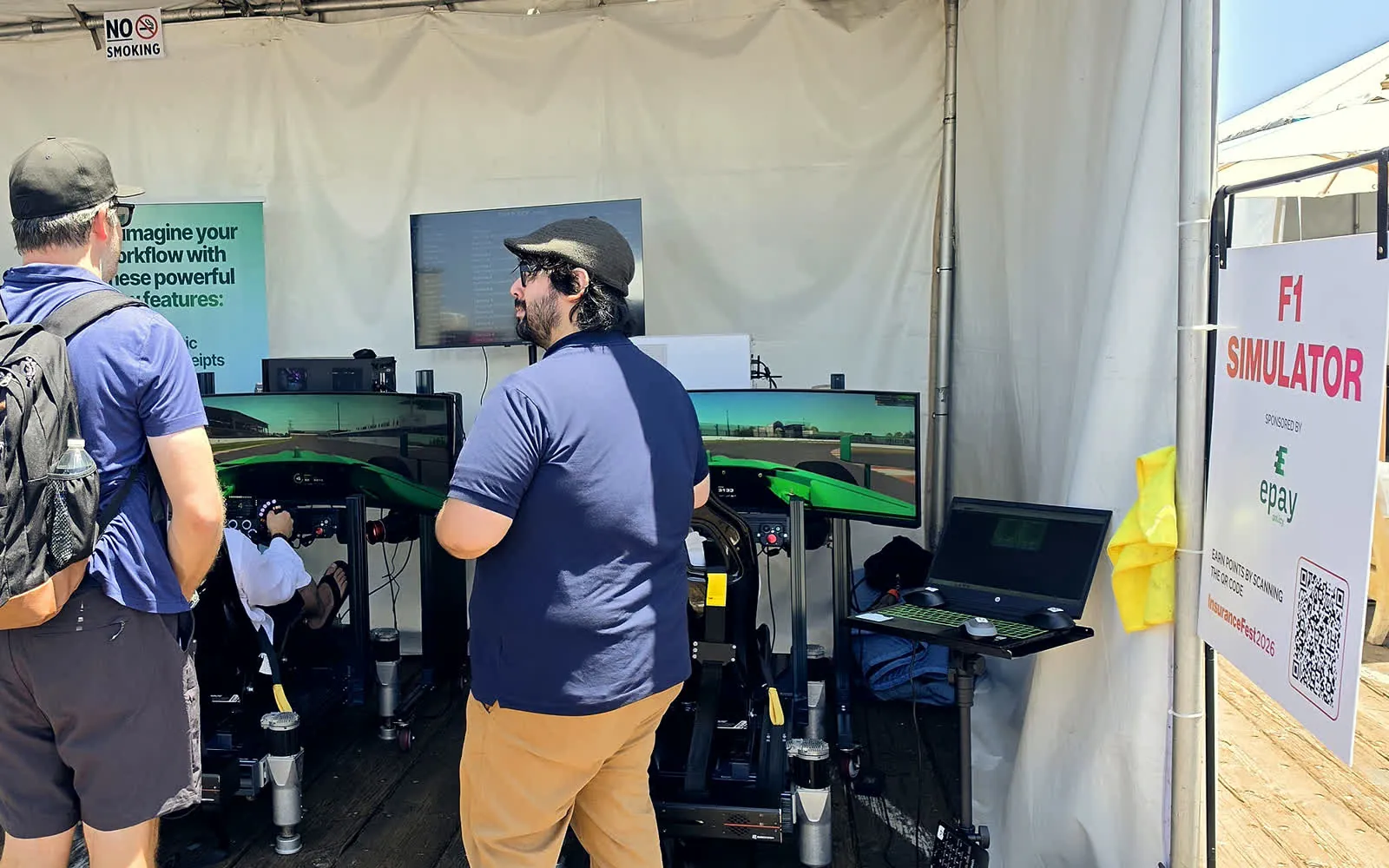
The expo hall, the breaks, and the evening reception. Sessions are short and timed, so the grid runs in the gaps your agenda already has rather than asking for a slot of its own. A live leaderboard brings people back between sessions.
Guide · Conferences
Conference entertainment that keeps attendees in the room.
Conference attention is a leaky bucket. Attendees arrive with a full schedule and start shedding sessions by mid-afternoon on day one. Entertainment that competes with the agenda makes that worse; entertainment that gives people a reason to stay on the floor fixes it.
The attention problem.
By the second afternoon, the hallway is winning. People are answering email, taking calls, or back at the hotel. Anything you programmed for that slot is competing with the entire rest of the attendee’s life.
The fix is not louder programming. It is an anchor on the floor that people opt into between sessions — short, repeatable, and social enough that being there is more appealing than leaving.
Where a racing activation sits in a run-of-show.
Sessions are short and timed, so a racing grid works in the gaps rather than against them. It runs continuously through breaks, receptions and expo hours without needing its own slot on the agenda.
A live leaderboard that persists across the whole event gives attendees a reason to come back — the standings are still there on day two, and so are the people trying to beat them.
It works as a sponsor asset.
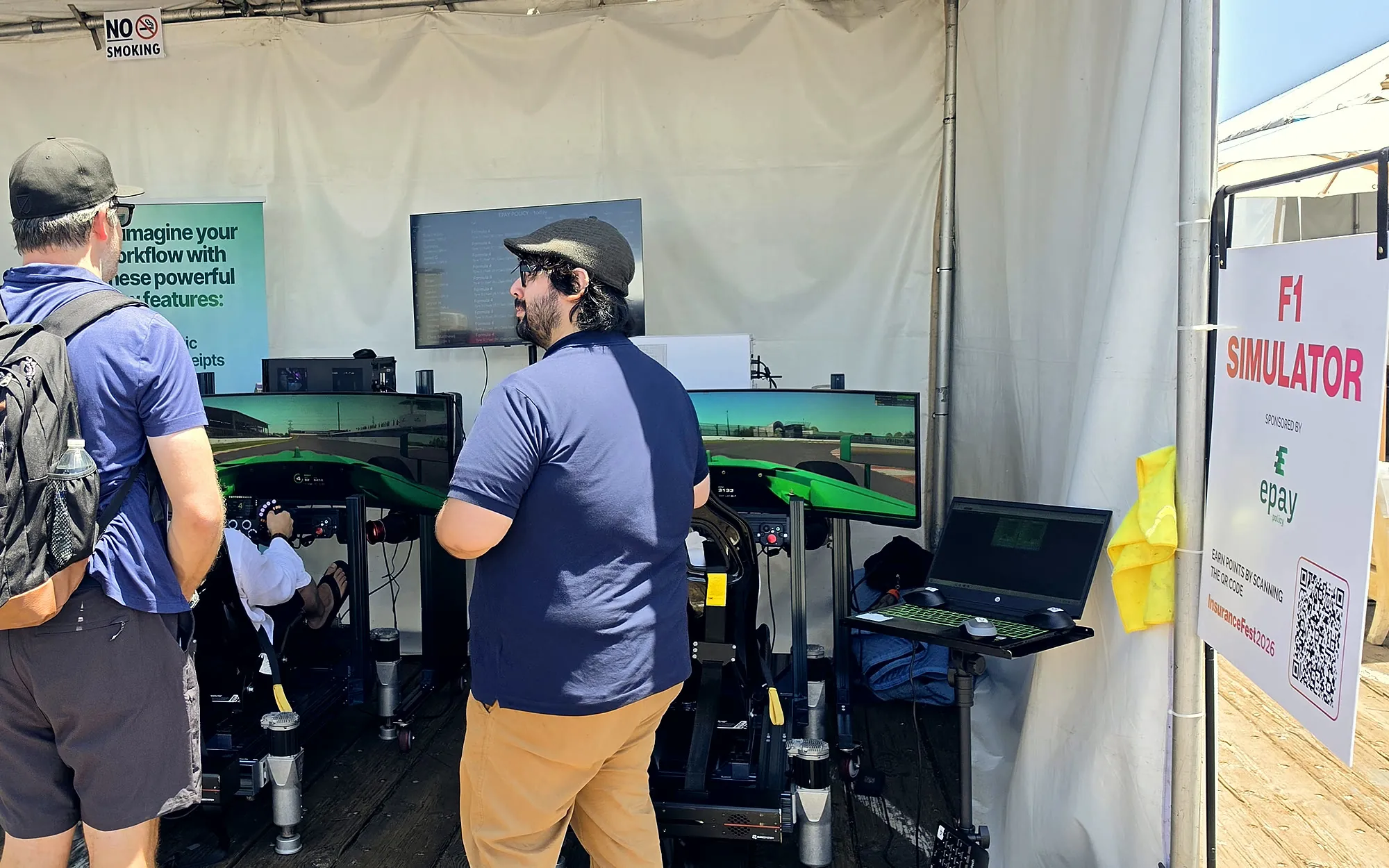
A sponsor can put their brand on the cars, the track and the broadcast, which turns a logo placement into something attendees actually interact with. At Insurance Fest on the Santa Monica Pier, an Epay Policy-branded Formula 4 activation produced 54 named contacts and roughly 18 hours of decision-maker attention in a single day, at 95% rig utilization.
Every participant can be captured as a recorded lead through the entry form rather than a fond memory, and the post-event report goes back to the sponsor with the numbers.
Working with the venue and show management.
We work within your exhibitor kit, load-in windows and any union labour rules, and we own it end to end — delivery, install, staffing and teardown, load-in to load-out, with a COI on file and run-of-show coordination with show management.
For multi-day programs, our crew runs the footprint continuously across every show day.
What we need from your venue.
Less than most people expect. Each simulator takes a footprint of about 5 ft wide by 8 ft deep in operation, and a pair with room to queue needs roughly 10 ft by 12 ft. Two rigs run off a single standard 110V wall outlet — no generators, no special wiring, no rewiring your ballroom.
We load in about three hours before doors and are packed out about an hour after close, all off the clock and outside your event hours. Indoors or out, ballroom or parking lot — exact arrival and clear times go into your run-of-show with the proposal.
Space & power
- Motion
- Full-motion
- Every rig. No static seats, no exceptions.
- Footprint
- 5′×8′
- Per rig in operation. 10′×12′ for a pair with room to queue.
- Power
- 1 outlet
- One standard 110V outlet per two rigs. No generators, no special wiring.
- Throughput
- 15–20
- Guests per hour, per simulator. Multiplies with every rig you add.
Lead time.
Plan on three to six months for a major show, where booth space and show deadlines drive the calendar. Multi-day deployments are quoted to scope around your footprint, show days and KPIs rather than sold as a package.
Where it goes in the agenda.
Three placements account for nearly everything we run at conferences: the expo hall floor, the breaks between sessions, and the evening reception. The common thread is that none of them compete with programming — the grid runs in the gaps the agenda already has.
A persistent leaderboard is what makes the gaps compound. Someone posts a time at the morning break and comes back at lunch to see whether it held. That returning traffic is the mechanism that keeps an expo hall busy at hour six, which is the hour organisers and exhibitors actually worry about.
How a sponsor underwrites it.
The activation is brandable end to end — custom liveries on the cars, boards on the virtual track, and the big-screen broadcast — which makes it straightforward for a sponsor to fund in exchange for measurable attention rather than another logo on a lanyard.
At Insurance Fest on the Santa Monica Pier, that arrangement produced 54 named contacts and 443 laps at 95% rig utilization across a single day for Epay Policy — roughly 18 hours of decision-maker attention, at 17 to 24 minutes per contact. The organiser gets the attraction; the sponsor gets a number they can take back to their own budget meeting.
Common questions
Yes, end to end — custom liveries on the cars, boards on the virtual track and the big-screen broadcast. Branding is produced ahead of load-in and approved by your team, so it reads as the sponsor’s activation rather than rented equipment in the corner.
Race sessions, unique drivers, throughput per hour, brand-exposure hours, first-time versus returning participants and simulated miles, handed back as a clean post-event report. Lead and survey capture can be integrated directly into the queue.
We own it end to end — delivery, install, staffing and teardown, load-in to load-out, with a COI on file, run-of-show coordination with show management, and a crew that runs the footprint continuously across a multi-day programme.
Three to six months for a major show, where booth space and show deadlines drive the calendar. Multi-day deployments are quoted to scope around your footprint, show days and KPIs rather than sold as a fixed package.
Proof from the floor
- —Epay Policy · Insurance Fest, Santa Monica Pier — 54 named contacts and roughly 18 hours of decision-maker attention in a single day.
- —MD&M West · Anaheim Convention Center — 589 unique drivers and ~323 brand-exposure hours across three days.
- —7th Sense Research · Long Beach Grand Prix — ~800 drivers engaged across three days on two simulators.
- —Booth ideas ranked by stopping power — an honest tier list.
- —Corporate event ideas — six occasions and what each one actually needs.
Programming a conference?
Tell us the show, the venue and your goals. One reply within one business day — availability and a single recommended program.